Showing posts with label Rose Morris. Show all posts

Sunday, 5 November 2017

Well, Minnie: An Echo of Ireland

By Rose Morris

As part of Manchester Irish Festival 2017, MIW wrote and performed original and historical work for our event, ‘Echoes of Ireland.’ Voices from our past echo down to us through the years and the miles, inspiring us to pass that echo on. 

My Echo comes from a letter written by my grand uncle, Francis, to his sister Minnie in San Francisco in 1915.  

A copy of the letter was brought back to Tyrone by his niece in the 1980’s when she visited Ireland for the first time in search of her roots. His niece was able to tell us that her mother would never have read this letter as she died giving birth to herself on the 29th September 1915.

The letter was dated 19th September and taking into account the time it would have taken for surface mail in those days it would not have arrived until after her death.


WELL, MINNIE


Irish Craveny, Ballygawley, Tyrone
19th September 1915. 
Well Minnie, dear sister.
Just a few lines
hoping to find you in good health.
These lines leave us fine.

Well Minnie, I have watched this long time
for a letter from you.
We have got Johnny married,
so that’s a change here.
She’s Roseanne O’Neill.
a neighbour of Susan’s.
Only twenty years of age.
That’s young enough to marry.
We are quite happy with her.
It was with all of her wishes.
She is good to mother and father.
That’s a great comfort to us.
It makes it alright
and that’s best of all.

Well Minnie, I am the only one left now
and it’s hard to say how I am to pull through,
for marryings make great changes you know
and my home will soon be over there too.


That’s all at present.
Hoping to hear from you soon.
They all join in sending best wishes
To your husband and family.
Your loving brother,
Francis McCann

Uncle Francis never did get to America, he moved out of his home to leave Johnny and his new wife their own space, lived alone as a bachelor until my mother looked after him in his old age at our house where he died in 1956.

This letter echoes a hidden story of his hopes and dreams of joining the rest of his emigrated family members. He never realised this dream and we never knew of it until it echoed again in the 1980’s long after he had gone.
~~~~~~~~~~~
Words & Images © Rose Morris

Rose Morris was born near Dungannon, in Co. Tyrone. Having retired from a career in Art and Design Education in Greater Manchester she now spends more time pursuing her creative interests and involvement in community projects in Manchester and Tyrone.
She co-founded the Manchester Irish Writers group with Alrene Hughes in 1994 and reckons that her continued involvement and sharing within that group has greatly enhanced the development of her own writing. 
Her monologues have been performed at the Library Theatre and the Royal Exchange and her short stories and poetry have been published in the Manchester Irish Writers’ collections; The End of the Rodden, The Retting Dam, Stone of the Heart, Drawing Breath and Changing Skies.

Rose wrote “Well Minnie” for MIW's Manchester Irish Festival event, “Echoes of Ireland”, which was performed at the Irish World Heritage Centre, Manchester in  March 2017.

Saturday, 15 April 2017

Proclaim the Dream: A Poem

By Rose Morris

Why were many of the poets and writers  of the Irish Cultural Revival at the beginning of the 20th century motivated to take up arms to fight for Irish Freedom? Why did some of them enlist to fight in the first World War?

For the latter I bring to mind Francis Ledwidge and Tom Kettle who were both preparing to fight for Irish freedom but decided instead to enlist in the British Army following John Redmond’s speech at Woodenbridge when he called on the Irish Volunteers 'to go wherever the firing line extends'.

Tom Kettle wrote a poem for his baby daughter, Betty, to try and explain his own reason for deserting her and going to war in France where he died in September 1916. He wanted her to know that he didn’t die for a king or a country, but “for a dream, that was born in a herdsman’s shed” and for ‘ the sacred scriptures of the poor'.

All the executed leaders of the 1916 Rising had their dreams too and they also left behind letters and parting words to their loved ones and these lines equally live on in this shared history.


PROCLAIM THE DREAM

Kilmainham Gaol. Dublin, Ireland
Photo credit: Carl Mikoy via Visualhunt.com / CC BY 2.0

Whether the dream was born in a herdsman’s shed 
Or died in a stone breakers’ yard it still lives on 
 Through rhyme and reason in many a heart, 
 A revised history, a contested legacy 

Some will look back and call it sublime
Some will say it was a glorious madness
The bittern will cry in the wild sky unheard 
And Pearce will have gone his way in sadness

Patrick Pearse
Image: Public domain, via Wikimedia Commons

Betty may have grown up cherishing her father’s lines 
Believing that he lies in shame with the foolish dead,
Where he fell at Ginchy, buried in some unknown grave
No honour, just blame, she a child of circumstance.

Thomas Kettle
Image: Public domain, via Wikimedia Commons

The sixteen who died for Ireland’s freedom
Will be more remembered for their gallant part,
Fifteen face a firing squad in Kilmainham prison yard.
Roger Casement  to hang on the gallows in Pentonville

Roger Casement
NLI Flickr / No Known Copyright Restrictions

Tearful mothers, weeping wives, lamenting lovers 
Take away lines and letters and parting gifts 
As brave men say last farewells and give reasons,
Denying futility, claiming the supreme sacrifice

“Your life, Seán, your beautiful life.”
Mary, take these four buttons from my coat,
The only gift Mac Diarmada had left to give
Joseph, my little man, be a priest if you can.

Seán Mac Diarmada
NLI Flickr / No Known Copyright Restrictions

Counting the cost, McDonagh was ready to pay 
And ‘his song floated upwards on the wings of daring’.
Ceannt faced the firing squad after his confession
Content that Ireland had shown she was a nation

Thomas McDonagh
NLI Flickr /No Known Copyright Restrictions

Heuston died on a soap box, a youthful, calm and fearless face
Joseph Plunkett went to death husband to his darling Grace
Marriage vows exchanged in the prison chapel, bayonets fixed
To the witness words of the Enniskillens chanting prayers.

Beside crucifix carrying priests they walked at dawn
To where a wooden box and sand bags marked a place,
Where they stood to wait, blindfolded and hands bound, 
Before their writhing bodies fell on blood they jointly shed. 

Kilmainham Gaol
Image by: psyberartist (Kilmainham Gaol)/ Wikimedia Commons (CC BY 2.0)

‘Untie my hands, remove the blindfold’. 
Wishes of McBride, duty bound, the officer denied.
A white target square upon his breast, Con Colbert 
Moved it to a higher place, upon his heart to rest. 

Thomas Clarke entrusted to his wife a final message
To let the Irish people know that he and fellow-signatories 
Had struck the first successful blow for freedom
And  the next blow would win through’. He died happy.

Michael O'Hanrahan
NLI Flickr / No Known Copyright Restrictions

Hanrahan, Daly and Willie Pearce joined freely in the fight
And walked to death as brave as any that had gone before.
Men of vision, Sons of Ireland, faithful and they fought
And the dream lived on in the conscious heart of a nation.

Irish Sky
Image by: By Fabiog82 (Own work)Wikimedia Commons (CC BY-SA 3.0)

~~~~~~~~~~
Text: © Rose Morris
Rose Morris was born near Dungannon, in Co. Tyrone. Having retired from a career in Art and Design Education in Greater Manchester she now spends more time pursuing her creative interests and involvement in community projects in Manchester and County Tyrone.
She co-founded the Manchester Irish Writers group with Alrene Hughes in 1994.
Her continued involvement and sharing within that group has greatly enhanced the development of her own writing. 
Her short stories, monologues and poetry have been included in the Manchester Irish Writers’ published collections; The End of the Rodden, The Retting Dam, Stone of the Heart, Drawing Breath and Changing Skies.

Rose wrote 'Proclaim the Dream' for MIW's commemorative event, '1916: The Risen Word', which was performed at the Irish World Heritage Centre, Manchester on March 10 2016. MIW received the generous support of the Embassy of Ireland for this event.


Saturday, 2 July 2016

Testimonies of Trauma: The Somme and other Battles in World War 1

By Rose Morris


Military History has described much of the four months of Somme battles in detail. The records of the regiments attacked and the weaponry used, the comprehensive casualty lists are always used to describe the horrors of the First World War. They explain to us what happened in facts and figures but do not tell the real human story and the conditions in which these men fought. They fail to describe the daily life of the soldier, or of the landscape in which he lived, fought and got injured or died. They do not tell of his family, the loved ones he left behind. It is only from the letters that were sent while alive that we get an insight into their human state, their thoughts and fears, their plight or their reasons for being there.

https://upload.wikimedia.org/wikipedia/commons/f/fb/The_Battle_of_the_Somme%2C_July-november_1916_Q4245.jpg

To learn more about this we are fortunate that the interpretation by poets and writers who enlisted, soldiers letters to their loved ones, artists such as Paul Nash, photographers like Fr. Frank Browne, of Titanic fame, and the diaries of survivors to enlighten us on this aspect of war as they present their observations and feelings in a more emotional and human way.

Over the past one hundred years, so much great writing has been sourced from World War 1 testimonies. Donegal writer Patrick McGill’s novel, The Great Push. Sean O’Casey’s play, The Silver Tassie. How Many Miles to Babylon, Jennifer Johnston’s novel.  Frank McGuiness’s play, Observe the Sons of Ulster Marching Towards the Somme.  A Long Long Way, Sebastian Barry’s novel.

The Silver Tassie by Sean O'Casey

They tell this story against a background of destruction, pungent smells and of mud and slime all of which appears to be ingrained in the mind of survivors, never to forgotten. Personal reports and stories of World War 1 describes men living like animals beneath the ground in trenches and dug-outs in a ‘world of mud’ and often makes use of words such as burrow and crawl, a language more associated with wildlife than human beings. Patrick McGill served as a stretcher-bearer on the Western Front, remarked “a soldier came crawling towards us on his belly, looking for all the world like a gigantic lobster that had escaped from its basket."

Often highlighted in these expressions is the soldier’s struggle with his conscience on his true reason for being there and his thoughts on the futility of war.

This can be more evident in the work of two Irish writers, Thomas Kettle and Francis Ledwidge for  they have also had to come to terms with fighting on behalf of a country which has historically been perceived as the enemy and both of them had been Irish Volunteers actively seeking independence alongside the poets and writers of the Celtic Revival who were among these executed in the 1916 Rising.

https://commons.wikimedia.org/wiki/File%3ATom_Kettle.jpg
Thomas Kettle

In his poem, To my Daughter Betty, A Gift From God,  Kettle leaves very little doubt as to his feelings and his fear that he would not survive the war. It is dated ‘In the field, before Guillemont, Somme, Sept. 4, 1916’. He was killed in the battlefield in Ginchy four days later.
So here, while the mad guns curse overhead

And tired men sigh with mud for couch and floor,

Know that we fools, now with the foolish dead

Died not for flag, nor King nor Emperor 

But for a dream, born in a herdsman's shed,

And for the secret Scripture of the poor.

In a letter to his brother Kettle wrote,
“I hope to come back. If not, I believe that to sleep here in the France I have loved is no harsh fate, and that so passing out into silence, I shall help towards the Irish settlement." 

https://commons.wikimedia.org/wiki/File%3AFrances_Ledwidge_from_Bain_collection.jpg
Francis Ledwidge

It is a striking contrast that Ledwidge’s war poetry, inspired by his memories of the natural habitat of his native County Meath, still retains a pastoral flavour while all around him was 'the muddy ranks of war’.
The hedges are all drowned in green grass seas,
 
And bobbing poppies flare like Elmo's light,
 
While siren-like the pollen-stained bees
 
Drone in the clover depths. And up the height
 
The cuckoo's voice is hoarse and broke with joy.
 
And on the lowland crops the crows make raid,.
 Before his death, Ledwidge wrote to the poet, Katherine Tynan:
"If I survive the war I have great hopes of writing something that will live. If not, I trust to be remembered in my own land for one or two things which its long sorrow inspired." 

He is, in fact, well remembered for his poem written after the execution of his friend Thomas McDonagh;
He shall not hear the bittern cry

In the wild sky, where he is lain,
Ledwidge was killed by an artillery shell at Ypres in 1917 and is buried in the cemetery at Artillery Wood at Boesinghe.

Kettle and Ledwidge have left behind a powerful testimony of their wartime experience as Irish nationalists in the British army. They speak to us on behalf of the many for whom we have no written record. They saw themselves engaged in a fight in Ireland's name and for Ireland's cause.

It is perhaps not wholly surprising that the writings of Kettle and Ledwidge have been overlooked. In Ireland. Their sacrifice was long overshadowed in modern Irish history which mainly dwelt on the General Post Office in 1916 rather than the Western Front.

Another interesting contrast is to be found in the literary responses from W.B. Yeats, who was not involved in military action yet he defines this particular period in Irish history and reflects on the dilemma of Irish men fighting in the British Army.
I know that I shall meet my fate
Somewhere among the clouds above;
Those that I fight I do not hate
Those that I guard I do not love.
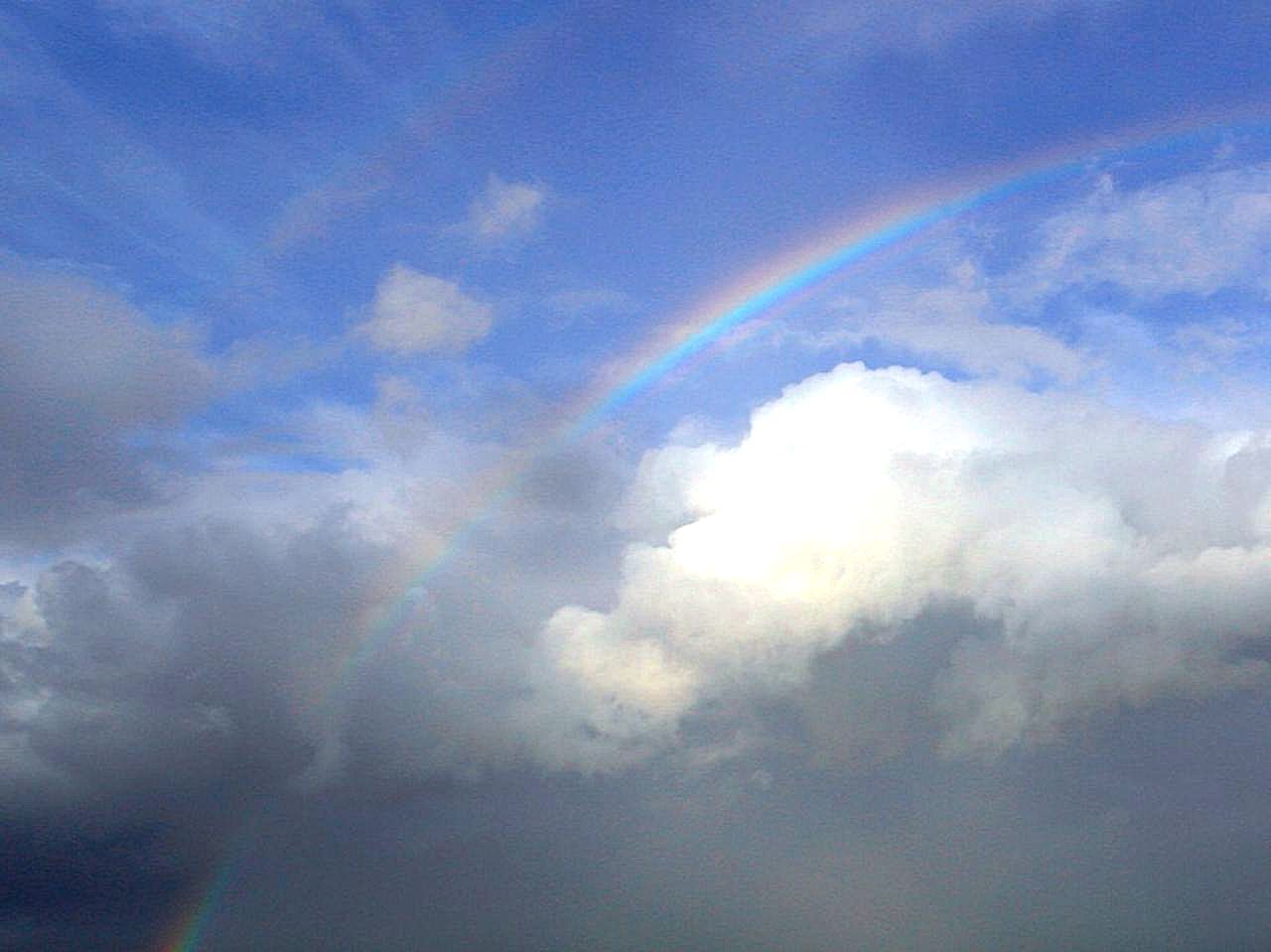
https://commons.wikimedia.org/wiki/File%3ARainbows_couds_sky.jpg

~~~~~~~~~~~~~
© Rose Morris
Rose Morris was born near Dungannon, in Co. Tyrone. Having retired from a career in Art and Design Education in Greater Manchester she now spends more time pursuing her creative interests and involvement in community projects in Manchester and County Tyrone.
She co-founded the Manchester Irish Writers group with Alrene Hughes in 1994.
Her continued involvement and sharing within that group has greatly enhanced the development of her own writing.
Her short stories, monologues and poetry have been included in the Manchester Irish Writers’ published collections; The End of the Rodden, The Retting Dam, Stone of the Heart, Drawing Breath and Changing Skies.

To find out more about MIW's Somme 100 Commemoration, please click here.