Showing posts with label Irish history. Show all posts

Sunday, 21 May 2017

Martin Duffy: One of the Forgotten Generation

By Kathleen Handrick


Mayo Peace Park, Castlebar
Image courtesy of  the Irish War Memorials website
'The Mayo Peace Park has consigned the ignorance and bitterness of the past into history. It does not seek to glorify or justify any war; its purpose is to commemorate the memory of the people of County Mayo who died in them. It was developed to remember a forgotten generation of brave heroic local people... whose service and sacrifice had been ignored and forgotten, indeed airbrushed out of modern Irish history until recent times.'  Irish War Memorials- Mayo Peace Park. 
Image © Kathleen Handrick

In 2010, I was very pleased to see the name of Martin Duffy, Donkey Man ( a Merchant Navy Stoker), inscribed on the beautiful memorial in the Mayo Peace Park, Castlebar.  Martin was my father’s uncle but unknown to later generations of the family.

Image © Kathleen Handrick

My research had begun a few years earlier.  I was interested in family history but knew very little of my Mayo roots even though I had close relatives still in Mayo. I think it seemed an odd concept to them that I would want to explore this. Perhaps because it was just part of their being, they were living within the history they felt there was no need to delve into the past.

As a child, my English mother had told me of names and places in her family but my father was very reticent. I used to meet people who came from Lacken, I knew the names of my family still living there but that was it.  There was nothing at all of his life experiences in Mayo.

I began by ordering the certificate of my grandparents’ marriage, Thomas Malley and Mary Duffy, and then began to trawl through microfilms at a library at the local Church of Jesus Christ of Latter - day Saints. It was a laborious and not very productive task as the parish records were scant.

 In 2003, I answered a posted request on an internet forum with regard to the Duffy family from Carrowtrasna, my grandmother’s town land. It was from Francis, in USA whose family had emigrated to Pennsylvania in the mid 1880s and although we felt that we might be related, there was no proof. Soon though, came a message from Francis, “I think I have found you a cousin!” and Ray, also in USA, proved to be my second cousin. Our grandmothers were sisters.

Map of Co. Mayo, 1841
British Library - no known copyright restrictions

Ray regularly visits Mayo and is a great researcher and we shared our knowledge. We found the Duffys in 1901 and 1911 censuses and thought that we had all our grandmothers’ siblings from those records.

In 2007, Ray asked if I had ever seen a photograph of a sailor in any of our Irish relatives’ homes. He could recall seeing one but was not sure where and he had found a commemoration of a Merchant Navy man, Martin Duffy, son of Michael and Mary of Carrowtrasna, Mayo on the Commonwealth Graves Commission (CWGC) website showing a death in 1916. Ray and I tried to find this death with no results.

I posted on a Family History site about our difficulties in tracing Martin and a kind person investigated and discovered that the date was wrong and arranged its correction. Martin Duffy, a Donkey man, Mercantile Marine, died in March 1918 when his ship SS Boorara was torpedoed in the English Channel. Four other men were killed that day together with Martin.

Image used with kind permission of the Australian War Memorial  

In the late 19th and early 20th centuries, local employment, in the townlands around Lacken, was to be found in farming and fishing but several men from the area enlisted in the Royal Navy, perhaps the natural choice for men who had lived by and understood the sea. Recent records show local men who took part in WW1, including the Battle of Jutland. One of the local survivors returned home but sadly died in a fishing tragedy a few years later in Lacken Bay. Several lives were lost that night.

Image © Kathleen Handrick

As more resources became available through internet sites, I was able to continue my research. Martin, aged 19 years, enlisted on the 5th August 1899, for 12 years as a Stoker in the Royal Navy. He served on several ships and his conduct was always ‘Very Good’. In 1911 census his ship, The Challenger, is shown as serving in the Australian Station.

L H Blakeney, an Able Seaman at the time, writes: ‘In 1911 I was in HMS Challenger, on way to Valparaiso, Chile, for Centenary celebrations. After visiting most of the large island groups we called at Tahiti, Pitcairn and Easter Island. First port of call on the West Coast of South America was Callao to coal ship and then to Valparaiso.”  He continues that after the celebrations, the ship called at the Panama Canal which was still under construction. ‘We coaled ship in 119° Fahrenheit. One chap received severe sunstroke, another became a bit funny in the head.’ The ship continued to Acapulco where there was ‘some sort of uprising’ taking place before returning to Sydney via Fiji. (Naval Historical Society of Australia)

Martin’s record shows that he left the navy in 1912 and nothing is known until the reports of his death in 1918 aboard SS Boorara, whilst serving as a donkey man, a Merchant Navy stoker. The Boorara was a former German ship which had been seized in Australian waters in 1914 and renamed. It was used for carrying troops, horses and supplies and was part of the Australian Mercantile fleet.

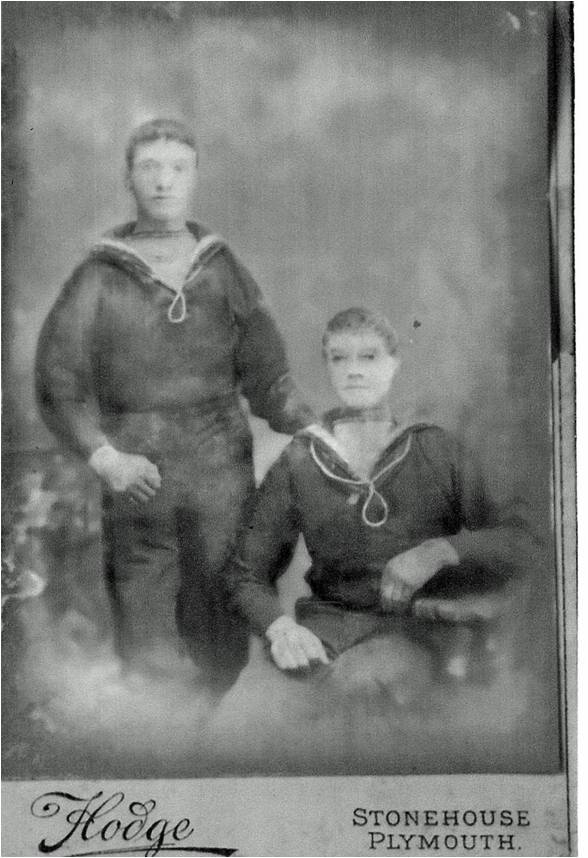
In 2014, I received a pleasant surprise when Ray emailed a copy of a very faded photograph. He had eventually found it, filed away in a cousin’s home.  No one knows which man is Martin. I can see family likenesses in both men!

No known copyright restrictions 

I titled this piece, ‘One of the Forgotten Generation’. It is difficult to say that Martin was ignored or forgotten within the family or perhaps just not spoken about as the generations passed. Recently published Irish records show that death was a too common experience in families at the time.  His parents, Michael and Mary had both died and his sister, my grandmother, was raising twelve children at the time of his death in 1918. Ray’s grandmother was in Pennsylvania raising her family. Martin died nineteen years after enlisting and may never have returned home in that time.  We do not know.

In December 2016, I was contacted by a member of the site where I had posted my request for information nine years earlier to say that the CWGC were searching for relatives of Martin Duffy as it was now confirmed that he was buried in an unmarked grave in Hollybrook Cemetery, Southampton, together with another man killed with him that day.

I contacted the organisation and was told that a headstone would now be erected by the Commonwealth Graves Commission and I was invited to suggest a memorial inscription. I spoke with Ray and relatives in Mayo and it was felt that a phrase in both Irish and English would be suitable if acceptable.

I recalled a hymn I had first heard at an Irish mass in St Mary’s Levenshulme, Manchester and suggested the lines: ‘I líonta Dé go gcastar sinn’ - ‘In the nets of God may we be caught’ and am pleased to say it was approved and was thought to be ‘most apt’.

Image used with kind permission of CWGC

I am so glad that Martin will now be honoured and become one of the remembered men who gave their lives during the conflict of WW1 but more importantly is now remembered within his own family.

Footnote:

I took a DNA test last year and in my list of close matches, Ray was the top known match as second cousin, which we knew, but do you remember Francis from 2003? There he is in the list, a likely third or fourth cousin! We were both delighted to receive the news after our chance internet encounter!

Postscript:

CWGC have now erected a headstone for Martin. I have also been contacted by Carole, from the Portsmouth diocese who researched Martin's burial. She was able to tell me details of the funeral and also that John Grennan, who was killed with Martin, was a young Roscommon man. Carole visited the new headstone and kindly placed some flowers there.

Image © Kathleen Handrick

~~~~~~~~~
© Kathleen Handrick


Kathleen Handrick is retired and lives in Oldham with her husband and family.  She joined MIW in 2013 as a novice writer and enjoys participating in the writers’ events. Her Irish roots are in County Mayo.

Saturday, 15 April 2017

Proclaim the Dream: A Poem

By Rose Morris

Why were many of the poets and writers  of the Irish Cultural Revival at the beginning of the 20th century motivated to take up arms to fight for Irish Freedom? Why did some of them enlist to fight in the first World War?

For the latter I bring to mind Francis Ledwidge and Tom Kettle who were both preparing to fight for Irish freedom but decided instead to enlist in the British Army following John Redmond’s speech at Woodenbridge when he called on the Irish Volunteers 'to go wherever the firing line extends'.

Tom Kettle wrote a poem for his baby daughter, Betty, to try and explain his own reason for deserting her and going to war in France where he died in September 1916. He wanted her to know that he didn’t die for a king or a country, but “for a dream, that was born in a herdsman’s shed” and for ‘ the sacred scriptures of the poor'.

All the executed leaders of the 1916 Rising had their dreams too and they also left behind letters and parting words to their loved ones and these lines equally live on in this shared history.


PROCLAIM THE DREAM

Kilmainham Gaol. Dublin, Ireland
Photo credit: Carl Mikoy via Visualhunt.com / CC BY 2.0

Whether the dream was born in a herdsman’s shed 
Or died in a stone breakers’ yard it still lives on 
 Through rhyme and reason in many a heart, 
 A revised history, a contested legacy 

Some will look back and call it sublime
Some will say it was a glorious madness
The bittern will cry in the wild sky unheard 
And Pearce will have gone his way in sadness

Patrick Pearse
Image: Public domain, via Wikimedia Commons

Betty may have grown up cherishing her father’s lines 
Believing that he lies in shame with the foolish dead,
Where he fell at Ginchy, buried in some unknown grave
No honour, just blame, she a child of circumstance.

Thomas Kettle
Image: Public domain, via Wikimedia Commons

The sixteen who died for Ireland’s freedom
Will be more remembered for their gallant part,
Fifteen face a firing squad in Kilmainham prison yard.
Roger Casement  to hang on the gallows in Pentonville

Roger Casement
NLI Flickr / No Known Copyright Restrictions

Tearful mothers, weeping wives, lamenting lovers 
Take away lines and letters and parting gifts 
As brave men say last farewells and give reasons,
Denying futility, claiming the supreme sacrifice

“Your life, Seán, your beautiful life.”
Mary, take these four buttons from my coat,
The only gift Mac Diarmada had left to give
Joseph, my little man, be a priest if you can.

Seán Mac Diarmada
NLI Flickr / No Known Copyright Restrictions

Counting the cost, McDonagh was ready to pay 
And ‘his song floated upwards on the wings of daring’.
Ceannt faced the firing squad after his confession
Content that Ireland had shown she was a nation

Thomas McDonagh
NLI Flickr /No Known Copyright Restrictions

Heuston died on a soap box, a youthful, calm and fearless face
Joseph Plunkett went to death husband to his darling Grace
Marriage vows exchanged in the prison chapel, bayonets fixed
To the witness words of the Enniskillens chanting prayers.

Beside crucifix carrying priests they walked at dawn
To where a wooden box and sand bags marked a place,
Where they stood to wait, blindfolded and hands bound, 
Before their writhing bodies fell on blood they jointly shed. 

Kilmainham Gaol
Image by: psyberartist (Kilmainham Gaol)/ Wikimedia Commons (CC BY 2.0)

‘Untie my hands, remove the blindfold’. 
Wishes of McBride, duty bound, the officer denied.
A white target square upon his breast, Con Colbert 
Moved it to a higher place, upon his heart to rest. 

Thomas Clarke entrusted to his wife a final message
To let the Irish people know that he and fellow-signatories 
Had struck the first successful blow for freedom
And  the next blow would win through’. He died happy.

Michael O'Hanrahan
NLI Flickr / No Known Copyright Restrictions

Hanrahan, Daly and Willie Pearce joined freely in the fight
And walked to death as brave as any that had gone before.
Men of vision, Sons of Ireland, faithful and they fought
And the dream lived on in the conscious heart of a nation.

Irish Sky
Image by: By Fabiog82 (Own work)Wikimedia Commons (CC BY-SA 3.0)

~~~~~~~~~~
Text: © Rose Morris
Rose Morris was born near Dungannon, in Co. Tyrone. Having retired from a career in Art and Design Education in Greater Manchester she now spends more time pursuing her creative interests and involvement in community projects in Manchester and County Tyrone.
She co-founded the Manchester Irish Writers group with Alrene Hughes in 1994.
Her continued involvement and sharing within that group has greatly enhanced the development of her own writing. 
Her short stories, monologues and poetry have been included in the Manchester Irish Writers’ published collections; The End of the Rodden, The Retting Dam, Stone of the Heart, Drawing Breath and Changing Skies.

Rose wrote 'Proclaim the Dream' for MIW's commemorative event, '1916: The Risen Word', which was performed at the Irish World Heritage Centre, Manchester on March 10 2016. MIW received the generous support of the Embassy of Ireland for this event.


Sunday, 9 April 2017

Boots on the Ground: Researching Medieval Ireland

By E.M. Powell

The island of Ireland occupied a unique place in the medieval world. It was, as far as the millions of inhabitants of Europe were concerned, It. Nothing else existed to the west (sorry, Americas). In a seventh century letter to the Pope, Saint Columbanus refers to the Irish as the ‘Dwellers at the Earth’s Edge.’ And even by the twelfth century, Gerald of Wales, royal clerk to England’s King Henry II, still confirmed Ireland as ‘the farthest western lands…Beyond the whole horizon only the ocean flows and is borne on in endless space.’

Ireland’s Atlantic Coast, Co. Cork.
© E.M. Powell

Now, Henry had a keen interest in Ireland and, as it happens, so do I—it being the land of my birth and all. But I also have a keen interest in Henry. The first two books in my medieval thriller Fifth Knight series have featured my fictional hero, Sir Benedict Palmer, in Henry’s service. Henry first arrived in Ireland in 1171. He had already sent troops there and he wanted to stamp his authority on it. But by 1185 it was in a state of major unrest, with native Irish kings and Henry’s Anglo-Norman barons who had taken Irish lands fighting it out for power.

The King had an ingenious solution: make his eighteen year old son Lord of Ireland and send him over to sort it out. And that son was John. Yes—the John who would one day be the infamous Bad King John. It says something about a British Royal when even Disney has a pop at them. John’s portrayal as a thumb-sucking lion prince in the classic animation Robin Hood is only one of many unflattering portrayals of him.

King John, as depicted c1372 on The Great Charter Roll in Waterford’s Medieval Museum.
© E.M. Powell

Trouble is, they aren’t far off the mark. John acquired his terrible reputation by simply being John. Suffice to say, his campaign in Ireland was a disaster—a gift to me as a novelist. A further gift was that the King’s clerk, Gerald, went with John, leaving us many first-hand accounts of what went on. And so, book #3, The Lord of Ireland, was born.

Of course I couldn’t send Sir Benedict Palmer off to the earth’s edge without first checking out the locations myself. Most historical fiction authors like to get their research feet on the ground where possible, and I’m no exception, especially when it involves a trip to Ireland.

John landed at the Port of Waterford on the south east coast on April 25 1185, with three hundred knights in tow. Still standing tall on Waterford’s quay is the medieval Reginald’s Tower, part of the old city’s fortifications which date from the time of the Vikings.

Reginald’s Tower, Waterford City.
© E.M. Powell

While the Tower would have looked a bit different in John’s day, we do know precisely what he did as he stood outside it. A group of powerful Irish chieftains came to pay tribute to him as Henry’s representative, greeting him as their lord. John’s response? Well, according to Gerald, John ‘pulled some of them about by their beards, which were large and flowing according to the native custom.’ Suitably angered and very unimpressed, the Irish made for the court of one of the Irish kings, where they reported back on the insults and how John was ‘a mere youth…a stripling who only listened to youthful advice.’ Worse, they decided that rather than make peace with John, they would ‘plot to resist [John’s force]…guard the privileges of their ancient freedom’ with their lives, and ‘make pacts’ to resist him. Oh, John.

Meanwhile, John began making grants of land to his own friends— land that loyal supporters of Henry already held. The result, according to Gerald, was that those who were dispossessed ‘went over to the side of the enemy.’ But John carried on. He set about establishing castles to take control of the land. We know from Gerald that there were three sites: Tibberaghny, in Co.  Kilkenny, Ardfinnan in Co. Tipperary and Lismore in Co. Waterford. Nothing remains of these structures, which were probably made of wood.

Ardfinnan Castle: rebuilt in the 18th & 19th Centuries.
© E.M. Powell

When I stopped off at Tibberaghny to check out the lie of the land, a man with a stick just happened to be walking past. (Note: this always happens in Ireland. There is always a man with a stick.) He a) enquired in a roundabout way what I was up to (also what AMWAS always does) and b) announced he was off to climb Slievenamon (in Irish, Sliabh na mBan) the mountain in the distance.

Slievenamon, Co. Tipperary- the mountain of the women.
© E.M. Powell

This was the point where it hit home that I had an extra layer of history. Yes, I was tracking the events of 800 years ago. But those boots of the Norman invaders were already tramping through history, through a land that had its unique ancient past. Slievenamon means ‘mountain of the women’. Legend has it that Fionn mac Cumhaill, Irish hero of the Fionn or Ossianic cycle of tales, and leader of a great band of warriors, chose his bride Gráinne from the winner of a group of young women who raced to meet him at the top of the mountain. Legend also has Fionn as a pragmatist: he secretly told the lovely Gráinne of a short cut, so she’d reach the summit first.

As for new arrival John in 1185, all was proceeding very badly. There were losses of life on both sides. He (or rather, his more able men) made a few gains, but his forces were well and truly routed in equal amounts by some of the native Irish kings. His less able men drank, caroused and fought with each other. When John failed to pay them, they deserted.

One would have thought that John would have accepted some responsibility for his failings. But no. Instead, he accused one of Henry’s men of treacherous dealings with the Irish. That man was Hugh de Lacy, Henry’s first Lord of Meath.

De Lacy is a major character in The Lord of Ireland. He was also a major thorn in Henry’s side, being far too good at his job for the King’s liking. He’d taken the ancient kingdom of Meath (Mide) from the Irish and constructed many castles. One was at the site of a sixth century monastery at Durrow in present day Co. Offaly. De Lacy’s mark on the land is no more. But the magnificent ninth century High Cross of Saint Colmcille still stands there, as it had done so 300 years before any Anglo-Norman’s arrival.

The Durrow High Cross and me. The cross dates from c850.
© E.M. Powell

De Lacy’s main castle was at Trim in Co. Meath. Trim is the largest Anglo-Norman castle in Ireland and still the best preserved and is incredibly impressive.

Hugh de Lacy’s Trim Castle.
© E.M. Powell


Trim Castle Interior.
© E.M. Powell

He’d also married a daughter of Rory O’Connor, the Irish High King. Some chroniclers suggest that de Lacy was lining up to take all of Ireland from Henry. We know John scuttled off to Dublin where he stayed until returning to Henry in December 1185, complaining bitterly about the Irish and Hugh de Lacy and blaming de Lacy for his failure.

In my novel, I add an extra layer. I needed a large monastery for the murdering climax of the book. And as large holy houses go, they don’t come much bigger than the Rock of Cashel. We don’t know if John ever visited, but Henry and Hugh de Lacy had stayed during the 1171 campaign. And to my joy, two of the buildings that stand now were there in 1185. Cormac’s Chapel was consecrated in 1134, magnificent inside and out.

Interior of Cormac’s Chapel, Cashel.
© E.M. Powell

And oldest of all, its Round Tower built around 1100. No one is quite sure what the exact purpose of Round Towers was, though they probably housed bells and valuables. But the architectural shape and form of Round Towers is unique to Ireland. They do things differently at the earth’s edge, y’know.

Round Tower & 13th Century Cathedral, Cashel.
© E.M. Powell

~~~~~~~~~~~~~
Text & Images © E.M. Powell
MIW member E.M. Powell was born in Cork City into the family of Michael Collins. She now lives in Manchester with her husband, daughter and a Facebook-friendly dog. Her medieval thriller Fifth Knight series has reached bestseller lists in the U.S., the U.K. and Germany. Book #3 in the series, The Lord of Ireland, was released in 2016. She is also a contributing editor to International Thriller Writers The Big Thrill magazine, blogs for English Historical Fiction Authors and is the social media manager for the Historical Novel Society. Find out more by visiting www.empowell.com

Monday, 23 January 2017

Constance Markievicz: The Revolutionary Countess

By Marion Riley


Countess Markievicz by John Butler Yeats
[Public domain], via Wikimedia Commons

Countess Markievicz was born Constance Gore-Booth in 1868 in London to Sir Henry Gore-Booth, the famous arctic explorer. As an Anglo-Irish landlord, her father was not typical of his type and administered his lands with a degree of compassion for the peasantry who farmed it. He is reported to have provided famine relief in 1879 at his estate in Sligo, This act of compassion undoubtedly inspired humanity and concern for the poor in his daughter. Living in Sligo, the family were friends with the family of W.B. Yeats, the poet.

Lissadell House, Ballinful, Co. Sligo- Constance's childhood home.
Photo: Kay Atherton [CC BY-SA 2.0], via Wikimedia Commons

Constance studied painting in London in 1893 where she became involved in the issue of suffrage for women, joining the 'National Union of Women's Suffrage Societies'. She continued her artistic studies in Paris in 1898 where she met Count Markievicz, who was a Ukrainian aristocrat of Polish origin. They wed in 1901 and returned to Sligo where their daughter Maeve was born. They settled in Dublin in 1903 where the Countess co-founded the 'United Artists Club' which was a cultural and artistic organisation. In 1908 she joined Sinn Fein. She continued to participate in the Suffragette movement in England and by standing for election she helped to defeat Winston Churchill in a 1908 Manchester by-election.

Open Christmas letter from the Suffragettes of Manchester.
Eva Gore-Booth, Constance's sister, is listed on there.
Image: Manchester Archives+ from Manchester, United Kingdom
[CC BY-SA 2.0], via Wikimedia Commons

In 1909 she established the radical 'Fianna Eireann' which was aimed at instructing a youth army in the use of firearms. She was jailed by the British authorities in 1913 after speaking at an IRB rally to protest the visit of George V to Dublin. She also joined the Irish Citizen Army (ICA) established by James Connolly.

As a Lieutenant in the ICA the Countess participated in the Easter Rising of 1916 where she was second-in-command at the fight on St. Stephens Green. Initially the rebels dug trenches in the green but soon retreated from this position once they became vulnerable to snipers positioned on the high buildings around the enclosed green. Under the command of Michael Mallin they occupied the Royal College of Surgeons, rebelling for a total of 6 days.

Studio portrait c.1915 of Countess Constance Markievicz (née Gore-Booth)
in uniform with a gun.
Photo: National Library of Ireland on The Commons (Flickr: Countess Markievicz)
[Public domain], via Wikimedia Commons

They surrendered only when they received a copy of Padraig Pearse's surrender order. The Countess was jailed in Kilmainham and sentenced to death but her sentence was commuted on grounds of her gender. She was released from prison in 1917 by which time the tide of support had turned in favour of the rebels and the path to independence was set.

In 1918 she was again jailed for her anti-conscription campaigning but upon release was elected to the English parliament, refusing to take her seat. She was the first woman to be elected to the House of Commons. She was a member of the first 'Dáil' (Irish Parliament) in 1919 and became the first Irish (and indeed European) Cabinet Minister, serving as Minister for Labour from 1919 to 1922.

Clare elections, victory procession led by pipers, with Countess Markievicz in white coat.
Photo: National Library of Ireland on The Commons [No restrictions], via Wikimedia Commons

She joined DeValera in opposition to the Anglo-Irish Treaty of 1922 which partitioned the country and fought in Dublin in the ensuing civil war. She was again imprisoned but this time by her former comrades-in-arms. Upon her release, she became a founder member of Fianna Fail and was elected to the fifth Dáil in 1927. DeValera had by this time changed tactics and intended to participate in the parliament. The Countess however, never got her chance when, at the age of 59, she died of tuberculosis (or possibly appendicitis) in July of 1927. She likely caught the disease while working in the Dublin slums. Her husband and family were by her side.

Glasnevin Cemetery
Photo: William Murphy from Dublin, Ireland [CC BY-SA 2.0], via Wikimedia Commons

She was buried in Glasnevin Cemetery in Dublin, the final resting place of so many Irish patriots with a farewell crowd of 300,000 in attendance.
~~~~~~
Text: © Marion Riley

Marion Riley was born in Limerick city and emigrated as a teenager to Manchester. She has worked in Sardinia, Spain, Switzerland and France. A winner and runner up of Irelands Own writing competitions, the magazine has published many of her stories and articles. Her monologues have been performed at the Library Theatre and the Royal Exchange and her poems and memoirs have been published in various anthologies such as Write North West. 
Two of her short story Films 'Curls of the Past' and 'Letting Go' are on the BBC website Telling Lives. She has also edited and published her late mother's memoirs' From Kerry Child to Limerick Lady.' Marion now lives in Sussex, close to daughter where there is space and peace for quiet reflection on life's transience.

Marion wrote a monologue 'I Did What Was Right & I Stand By It' based on Countess Markievicz's life for MIW's commemorative event, '1916: The Risen Word'. 1916TRW was performed at the Irish World Heritage Centre, Manchester on March 10 2016. MIW received the generous support of the Embassy of Ireland for this event.


Sunday, 22 May 2016

Beauty Born: A Poem

By E.M. Powell

In Ireland's 1916 Easter Rising, 590 people were killed:  374 civilians, 116 British Soldiers, 77 insurgents and 23 members of the police forces. But these figures do not show that 40 were children aged 16 and under. Irish broadcaster and writer Joe Duffy has told their story in his moving book, 'Children of the Rising', and it was one of those accounts that inspired me to write this piece.


Little Sean Francis Foster was one of the first to lose his life in the Rising on Easter Monday morning. He was in his pram when he was shot, according to his death certificate, ‘through the head at the level of ears’. His mother, Katie, was with him. He was two years and ten months old. My poem, 'Beauty Born', is about that event.

BEAUTY BORN


This death carriage needs no plumed horse to turn heads to its passing,
with ripped hood and scorched cover that skewer every eye.
The cheerful sun stares down on shattered glass 
and splashed milk, and every running streak 
turns bile-sharp in its gaze. 

Smeared berry red, a tiny mouth yields only iron’s tang 
to pleading, screaming kisses. The silent wound 
that gapes, that glisters with afterbirth’s deep warmth, 
will never need a doubter’s hand to test 
a rapid resurrection. 

No close-worked wool or crochet shawl will halt its lasting cool.
Void-stained creases are washed and rinsed with soft cotton and water,
cut through with salted torrent from a womb’s unemptying font.
Then dried with care and covered clean and dry and stiff with starch
to aid a peaceful rest. 

Hands on beads beg for reprieve to the Virgin whose man-child 
visited but three days’ death before rising up again.
Yet only silence leaves the lowly beggar to hang on nails of grief,
while those who latched on to a dream, suckled hard with eager mouth,
stalk through time like Lazarus, 
and beauty born is gone. 


~~~~~~~~~~~~
Image credits:
'Children of the Rising' by Joe Duffy cover: © Central Press/Getty Images.
Pram: Livrustkammaren (The Royal Armoury) / Samuel Uhrdin / CC BY-SA via Wikimedia Commons
Celtic cross is © E.M. Powell.

MIW member E.M. Powell was born in Cork City into the family of Michael Collins. 

She now lives in Manchester with her husband, daughter and a Facebook-friendly dog. Her medieval thriller Fifth Knight series has reached bestseller lists in the U.S., the U.K. and Germany.

Book #3, THE LORD OF IRELAND, was published by Thomas & Mercer on April 5 2016. She is also a contributing editor to International Thriller Writers The Big Thrill magazine, blogs for & edits English Historical Fiction Authors, and reviews fiction & non-fiction for the Historical Novel Society and is part of the HNS social media team. Her website can be found at www.empowell.com.

Elaine wrote 'Beauty Born' for MIW's commemorative event, '1916: The Risen Word', which was performed at the Irish World Heritage Centre, Manchester on March 10 2016. MIW received the generous support of the Embassy of Ireland for this event.


Sunday, 15 May 2016

Summer 1979: Poem.

By Patrick Slevin

In 1979 we were holidaying at my aunt's in Ballinamore, Leitrim. On a day trip to my father's home town of Westport we visited a relative's house where there was a picture of the signing of the declaration of the Irish Republic. I was six years old and mistook it for the Last Supper. 


In this poem, it is the journey to a relative's house which is described, as well as the journey my father's emigrant generation took-- and also the relationship second generation Irish have with the home they will never live in but are brought up to believe they are forever connected with.


SUMMER 1979

Brought back for summer headlines before the
Copy warmed, the sixth edition ran
Stories, from another press. Black on white
And black on red, borrowed plates to serve 

The picnic, the temporary Beetle meandered
Under the Eagle’s weary eye. Beyond
McBride’s, beyond the Quay, beyond those
Leitrim two-week lanes. My father took the


Uncle’s chair, a Covey coming back to 
Where he’d kangarooed Brylcreem style, long
Before the Boomtown Rats. All day to look
At Old Head rain and then the favela 


Of the dead, grass swept under tarmac before 
A turkey ran me laps. Outside familiar 
Frames, slurred voices hid by welcome turf,
Strangers disguised as cousins, grandsons

Of the same revolt. We stood as victims 
Of a reclaiming Empire while they just 
Farmed the family acres. Mistaken 
Apostles gazed down on us, rising  


For the last supper. Explanations came  
Thick and fast, inside that room I could have 
Cried and cried. Laughter didn’t ease the pain
Amongst the vow of silence. Cajoled, hair   

Ruffled, amid proclamations of what  
Would you expect? We broke bread together,   
I suppose I was one of them. The  
Collection envelopes had gathered 

Once, in that house where the missed still shone. 
In the slumbered sunset, isolated 
Dreams had long since dimmed. They talked us round 
Whispered routes, of English wakes, of 

Lavery’s next years. Looking out for names 
On maps, exhausted fumes carried fresh goodbyes. 
Down a silent unlit road, looking for 
Directions home, but home was someone 


Else’s house, where we’d never live. Soldiers 
Without much song in our heart. Loaded full 
With heavy salutes. For fallen comrades 

And for us. For the land of heroes gone.

~~~~~~~~~~~~

Manchester Irish Member Patrick Slevin lives in Stockport. He has been writing poems and stories for many years.

The images and text used in this post are © Patrick Slevin except for the image of the 1916 signatories which is in the Public Domain.


Patrick wrote 'Summer 1916' for MIW's commemorative event, '1916: The Risen Word', which was performed at the Irish World Heritage Centre, Manchester on March 10 2016. MIW received the generous support of the Embassy of Ireland for this event.