By Kathleen Handrick
In 2010, I was very pleased to see the name of Martin Duffy, Donkey Man ( a Merchant Navy Stoker), inscribed on the beautiful memorial in the Mayo Peace Park, Castlebar. Martin was my father’s uncle but unknown to later generations of the family.
My research had begun a few years earlier. I was interested in family history but knew very little of my Mayo roots even though I had close relatives still in Mayo. I think it seemed an odd concept to them that I would want to explore this. Perhaps because it was just part of their being, they were living within the history they felt there was no need to delve into the past.
As a child, my English mother had told me of names and places in her family but my father was very reticent. I used to meet people who came from Lacken, I knew the names of my family still living there but that was it. There was nothing at all of his life experiences in Mayo.
I began by ordering the certificate of my grandparents’ marriage, Thomas Malley and Mary Duffy, and then began to trawl through microfilms at a library at the local Church of Jesus Christ of Latter - day Saints. It was a laborious and not very productive task as the parish records were scant.
In 2003, I answered a posted request on an internet forum with regard to the Duffy family from Carrowtrasna, my grandmother’s town land. It was from Francis, in USA whose family had emigrated to Pennsylvania in the mid 1880s and although we felt that we might be related, there was no proof. Soon though, came a message from Francis, “I think I have found you a cousin!” and Ray, also in USA, proved to be my second cousin. Our grandmothers were sisters.
Ray regularly visits Mayo and is a great researcher and we shared our knowledge. We found the Duffys in 1901 and 1911 censuses and thought that we had all our grandmothers’ siblings from those records.
In 2007, Ray asked if I had ever seen a photograph of a sailor in any of our Irish relatives’ homes. He could recall seeing one but was not sure where and he had found a commemoration of a Merchant Navy man, Martin Duffy, son of Michael and Mary of Carrowtrasna, Mayo on the Commonwealth Graves Commission (CWGC) website showing a death in 1916. Ray and I tried to find this death with no results.
I posted on a Family History site about our difficulties in tracing Martin and a kind person investigated and discovered that the date was wrong and arranged its correction. Martin Duffy, a Donkey man, Mercantile Marine, died in March 1918 when his ship SS Boorara was torpedoed in the English Channel. Four other men were killed that day together with Martin.
In the late 19th and early 20th centuries, local employment, in the townlands around Lacken, was to be found in farming and fishing but several men from the area enlisted in the Royal Navy, perhaps the natural choice for men who had lived by and understood the sea. Recent records show local men who took part in WW1, including the Battle of Jutland. One of the local survivors returned home but sadly died in a fishing tragedy a few years later in Lacken Bay. Several lives were lost that night.
As more resources became available through internet sites, I was able to continue my research. Martin, aged 19 years, enlisted on the 5th August 1899, for 12 years as a Stoker in the Royal Navy. He served on several ships and his conduct was always ‘Very Good’. In 1911 census his ship, The Challenger, is shown as serving in the Australian Station.
L H Blakeney, an Able Seaman at the time, writes: ‘In 1911 I was in HMS Challenger, on way to Valparaiso, Chile, for Centenary celebrations. After visiting most of the large island groups we called at Tahiti, Pitcairn and Easter Island. First port of call on the West Coast of South America was Callao to coal ship and then to Valparaiso.” He continues that after the celebrations, the ship called at the Panama Canal which was still under construction. ‘We coaled ship in 119° Fahrenheit. One chap received severe sunstroke, another became a bit funny in the head.’ The ship continued to Acapulco where there was ‘some sort of uprising’ taking place before returning to Sydney via Fiji. (Naval Historical Society of Australia)
Martin’s record shows that he left the navy in 1912 and nothing is known until the reports of his death in 1918 aboard SS Boorara, whilst serving as a donkey man, a Merchant Navy stoker. The Boorara was a former German ship which had been seized in Australian waters in 1914 and renamed. It was used for carrying troops, horses and supplies and was part of the Australian Mercantile fleet.
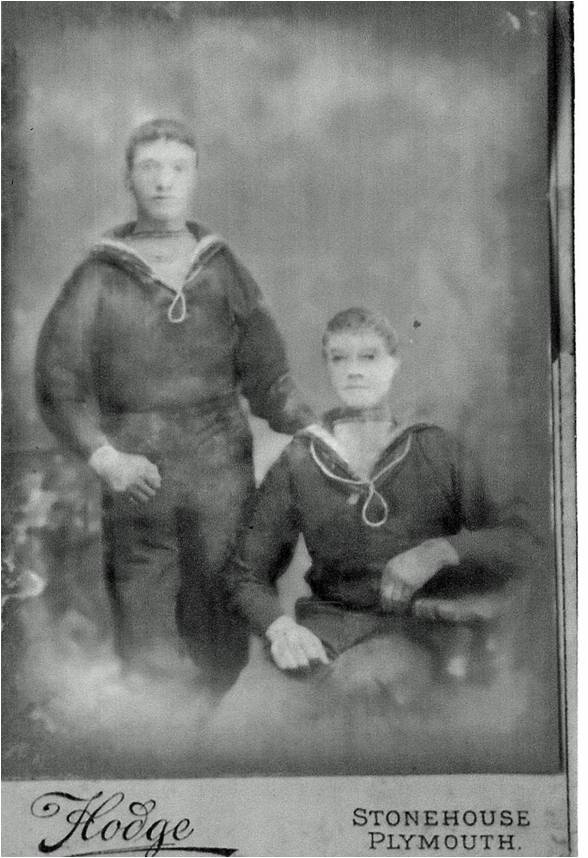
In 2014, I received a pleasant surprise when Ray emailed a copy of a very faded photograph. He had eventually found it, filed away in a cousin’s home. No one knows which man is Martin. I can see family likenesses in both men!
I titled this piece, ‘One of the Forgotten Generation’. It is difficult to say that Martin was ignored or forgotten within the family or perhaps just not spoken about as the generations passed. Recently published Irish records show that death was a too common experience in families at the time. His parents, Michael and Mary had both died and his sister, my grandmother, was raising twelve children at the time of his death in 1918. Ray’s grandmother was in Pennsylvania raising her family. Martin died nineteen years after enlisting and may never have returned home in that time. We do not know.
In December 2016, I was contacted by a member of the site where I had posted my request for information nine years earlier to say that the CWGC were searching for relatives of Martin Duffy as it was now confirmed that he was buried in an unmarked grave in Hollybrook Cemetery, Southampton, together with another man killed with him that day.
I contacted the organisation and was told that a headstone would now be erected by the Commonwealth Graves Commission and I was invited to suggest a memorial inscription. I spoke with Ray and relatives in Mayo and it was felt that a phrase in both Irish and English would be suitable if acceptable.
I recalled a hymn I had first heard at an Irish mass in St Mary’s Levenshulme, Manchester and suggested the lines: ‘I líonta Dé go gcastar sinn’ - ‘In the nets of God may we be caught’ and am pleased to say it was approved and was thought to be ‘most apt’.
I am so glad that Martin will now be honoured and become one of the remembered men who gave their lives during the conflict of WW1 but more importantly is now remembered within his own family.
Footnote:
I took a DNA test last year and in my list of close matches, Ray was the top known match as second cousin, which we knew, but do you remember Francis from 2003? There he is in the list, a likely third or fourth cousin! We were both delighted to receive the news after our chance internet encounter!
Postscript:
CWGC have now erected a headstone for Martin. I have also been contacted by Carole, from the Portsmouth diocese who researched Martin's burial. She was able to tell me details of the funeral and also that John Grennan, who was killed with Martin, was a young Roscommon man. Carole visited the new headstone and kindly placed some flowers there.

 |
| Mayo Peace Park, Castlebar Image courtesy of the Irish War Memorials website |
'The Mayo Peace Park has consigned the ignorance and bitterness of the past into history. It does not seek to glorify or justify any war; its purpose is to commemorate the memory of the people of County Mayo who died in them. It was developed to remember a forgotten generation of brave heroic local people... whose service and sacrifice had been ignored and forgotten, indeed airbrushed out of modern Irish history until recent times.' Irish War Memorials- Mayo Peace Park.
 |
| Image © Kathleen Handrick |
In 2010, I was very pleased to see the name of Martin Duffy, Donkey Man ( a Merchant Navy Stoker), inscribed on the beautiful memorial in the Mayo Peace Park, Castlebar. Martin was my father’s uncle but unknown to later generations of the family.
 |
| Image © Kathleen Handrick |
My research had begun a few years earlier. I was interested in family history but knew very little of my Mayo roots even though I had close relatives still in Mayo. I think it seemed an odd concept to them that I would want to explore this. Perhaps because it was just part of their being, they were living within the history they felt there was no need to delve into the past.
As a child, my English mother had told me of names and places in her family but my father was very reticent. I used to meet people who came from Lacken, I knew the names of my family still living there but that was it. There was nothing at all of his life experiences in Mayo.
I began by ordering the certificate of my grandparents’ marriage, Thomas Malley and Mary Duffy, and then began to trawl through microfilms at a library at the local Church of Jesus Christ of Latter - day Saints. It was a laborious and not very productive task as the parish records were scant.
In 2003, I answered a posted request on an internet forum with regard to the Duffy family from Carrowtrasna, my grandmother’s town land. It was from Francis, in USA whose family had emigrated to Pennsylvania in the mid 1880s and although we felt that we might be related, there was no proof. Soon though, came a message from Francis, “I think I have found you a cousin!” and Ray, also in USA, proved to be my second cousin. Our grandmothers were sisters.
 |
| Map of Co. Mayo, 1841 British Library - no known copyright restrictions |
Ray regularly visits Mayo and is a great researcher and we shared our knowledge. We found the Duffys in 1901 and 1911 censuses and thought that we had all our grandmothers’ siblings from those records.
In 2007, Ray asked if I had ever seen a photograph of a sailor in any of our Irish relatives’ homes. He could recall seeing one but was not sure where and he had found a commemoration of a Merchant Navy man, Martin Duffy, son of Michael and Mary of Carrowtrasna, Mayo on the Commonwealth Graves Commission (CWGC) website showing a death in 1916. Ray and I tried to find this death with no results.
I posted on a Family History site about our difficulties in tracing Martin and a kind person investigated and discovered that the date was wrong and arranged its correction. Martin Duffy, a Donkey man, Mercantile Marine, died in March 1918 when his ship SS Boorara was torpedoed in the English Channel. Four other men were killed that day together with Martin.
 |
| Image used with kind permission of the Australian War Memorial |
In the late 19th and early 20th centuries, local employment, in the townlands around Lacken, was to be found in farming and fishing but several men from the area enlisted in the Royal Navy, perhaps the natural choice for men who had lived by and understood the sea. Recent records show local men who took part in WW1, including the Battle of Jutland. One of the local survivors returned home but sadly died in a fishing tragedy a few years later in Lacken Bay. Several lives were lost that night.
 |
| Image © Kathleen Handrick |
As more resources became available through internet sites, I was able to continue my research. Martin, aged 19 years, enlisted on the 5th August 1899, for 12 years as a Stoker in the Royal Navy. He served on several ships and his conduct was always ‘Very Good’. In 1911 census his ship, The Challenger, is shown as serving in the Australian Station.
L H Blakeney, an Able Seaman at the time, writes: ‘In 1911 I was in HMS Challenger, on way to Valparaiso, Chile, for Centenary celebrations. After visiting most of the large island groups we called at Tahiti, Pitcairn and Easter Island. First port of call on the West Coast of South America was Callao to coal ship and then to Valparaiso.” He continues that after the celebrations, the ship called at the Panama Canal which was still under construction. ‘We coaled ship in 119° Fahrenheit. One chap received severe sunstroke, another became a bit funny in the head.’ The ship continued to Acapulco where there was ‘some sort of uprising’ taking place before returning to Sydney via Fiji. (Naval Historical Society of Australia)
Martin’s record shows that he left the navy in 1912 and nothing is known until the reports of his death in 1918 aboard SS Boorara, whilst serving as a donkey man, a Merchant Navy stoker. The Boorara was a former German ship which had been seized in Australian waters in 1914 and renamed. It was used for carrying troops, horses and supplies and was part of the Australian Mercantile fleet.
In 2014, I received a pleasant surprise when Ray emailed a copy of a very faded photograph. He had eventually found it, filed away in a cousin’s home. No one knows which man is Martin. I can see family likenesses in both men!
 |
| No known copyright restrictions |
I titled this piece, ‘One of the Forgotten Generation’. It is difficult to say that Martin was ignored or forgotten within the family or perhaps just not spoken about as the generations passed. Recently published Irish records show that death was a too common experience in families at the time. His parents, Michael and Mary had both died and his sister, my grandmother, was raising twelve children at the time of his death in 1918. Ray’s grandmother was in Pennsylvania raising her family. Martin died nineteen years after enlisting and may never have returned home in that time. We do not know.
In December 2016, I was contacted by a member of the site where I had posted my request for information nine years earlier to say that the CWGC were searching for relatives of Martin Duffy as it was now confirmed that he was buried in an unmarked grave in Hollybrook Cemetery, Southampton, together with another man killed with him that day.
I contacted the organisation and was told that a headstone would now be erected by the Commonwealth Graves Commission and I was invited to suggest a memorial inscription. I spoke with Ray and relatives in Mayo and it was felt that a phrase in both Irish and English would be suitable if acceptable.
I recalled a hymn I had first heard at an Irish mass in St Mary’s Levenshulme, Manchester and suggested the lines: ‘I líonta Dé go gcastar sinn’ - ‘In the nets of God may we be caught’ and am pleased to say it was approved and was thought to be ‘most apt’.
 |
| Image used with kind permission of CWGC |
I am so glad that Martin will now be honoured and become one of the remembered men who gave their lives during the conflict of WW1 but more importantly is now remembered within his own family.
Footnote:
I took a DNA test last year and in my list of close matches, Ray was the top known match as second cousin, which we knew, but do you remember Francis from 2003? There he is in the list, a likely third or fourth cousin! We were both delighted to receive the news after our chance internet encounter!
Postscript:
CWGC have now erected a headstone for Martin. I have also been contacted by Carole, from the Portsmouth diocese who researched Martin's burial. She was able to tell me details of the funeral and also that John Grennan, who was killed with Martin, was a young Roscommon man. Carole visited the new headstone and kindly placed some flowers there.
 |
| Image © Kathleen Handrick |
~~~~~~~~~
© Kathleen Handrick

Kathleen Handrick is retired and lives in Oldham with her husband and family. She joined MIW in 2013 as a novice writer and enjoys participating in the writers’ events. Her Irish roots are in County Mayo.


