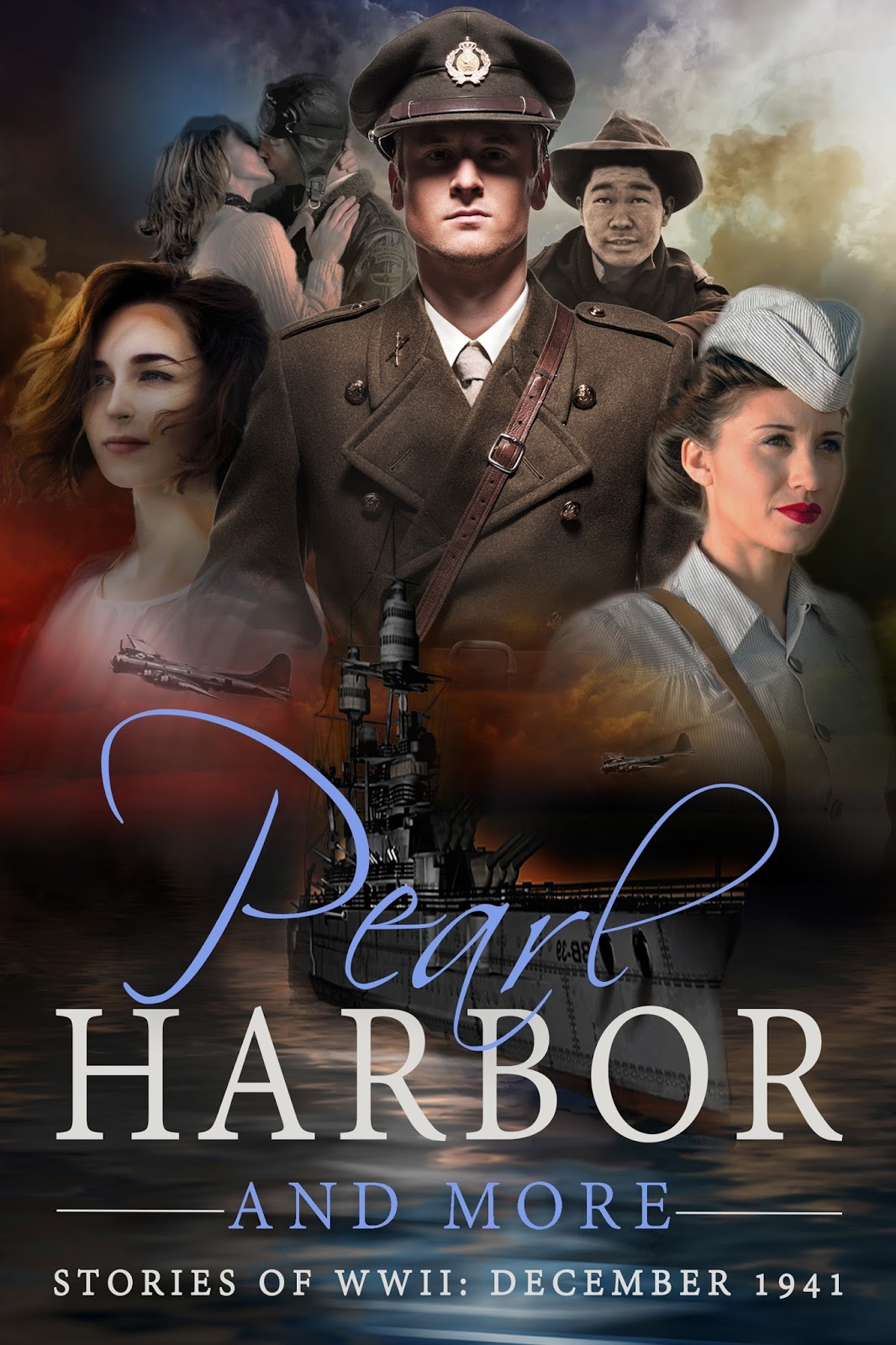
MIW are pleased to welcome a guest to our blog today. Dianne Ascroft is a member of Fermanagh Writers in Northern Ireland and writes WWII historical fiction. Her latest publication is as part of a short story collection, Pearl Harbor and More, which has been released by an international group of writers to mark the 75th anniversary of the battle of Pearl Harbour. Dianne’s story, Allies After All, is set in County Fermanagh during December 1941. In this post, she gives us an insight into the history of NI during the war and shares an excerpt from her story.
As part of the United Kingdom, Northern Ireland had already been at war for more than two years when my story opens. But, it was the same, yet a different, war than the rest of the United Kingdom was waging. Due to the political and religious tensions in the province, some aspects of the province’s experience of the war differed greatly from the rest of the United Kingdom. They faced rationing, the fear of invasion by Axis troops and many saw their loved ones go off to fight.
But conscription was never introduced so those who joined the armed forces did so voluntarily. This meant that more men of military service age remained at home than in other parts of the UK. But what the province didn’t supply in manpower, they made up for with industrial output. Northern Ireland’s industries supplied ships, aircraft, munitions and cloth for the armed forces.
County Fermanagh, in the west of the province, did its part for the war effort with increased crop yields and milk production for consumption locally and across the Irish Sea in England. Bordering neutral Ireland, the county was in a unique position. The hardships of rationing were offset by a thriving cross border smuggling trade between the two countries. Yet, at the same time, the Unionists in Fermanagh constantly worried about the proximity of the border, fearing that the IRA would sneak across it to attack the local targets, sabotage military operations in the county and aide Axis forces to infiltrate the province.
Local defence throughout Northern Ireland was overseen by the police rather than the military, in order to employ their local knowledge to prevent anyone with suspected terrorist connections from being accepted into the organisation. Thus, the Local Defence Force, which later became the Ulster Home Guard, was a branch of the police force.
Northern Ireland was also a staging platform for the Allied troops that arrived in the United Kingdom to prepare for the invasion of occupied Europe. This included the Americans. Although America was neutral until the attack on Pearl Harbor pushed them into the war, they had already been in Northern Ireland for months, secretly preparing for their entry into the war. The construction of military installations by American civilian contractors, in various places in the United Kingdom, including
County Fermanagh, was already well underway by December 1941.
When my story opens, an American mechanic, Art Miller, working for a civilian company on the construction of ammunition storage dump facilities, meets Robbie Hetherington, a member of the Local Defence Force in County Fermanagh with interesting results. Here’s the excerpt from my story:


 Dianne Ascroft is a Canadian writer living in Northern Ireland. She writes historical and contemporary fiction, often with an Irish connection. Her series The Yankee Years is a collection of Short Reads and novels set in World War II–era Northern Ireland. Her other writing includes a ghost tale inspired by the famous Coonian ghost, An Unbidden Visitor; a short story collection, Dancing Shadows, Tramping Hooves, and an historical novel, Hitler and Mars Bars. She is lives on a farm near Enniskillen, County Fermanagh and is a member of Fermanagh Writers, Writers Abroad, the Historical Novel Society and the Alliance of Independent Authors.

ALLIES AFTER ALL
By Dianne Ascroft
 |
| Fermanagah Fields |
As part of the United Kingdom, Northern Ireland had already been at war for more than two years when my story opens. But, it was the same, yet a different, war than the rest of the United Kingdom was waging. Due to the political and religious tensions in the province, some aspects of the province’s experience of the war differed greatly from the rest of the United Kingdom. They faced rationing, the fear of invasion by Axis troops and many saw their loved ones go off to fight.
But conscription was never introduced so those who joined the armed forces did so voluntarily. This meant that more men of military service age remained at home than in other parts of the UK. But what the province didn’t supply in manpower, they made up for with industrial output. Northern Ireland’s industries supplied ships, aircraft, munitions and cloth for the armed forces.
 |
| Lough Erne, Co Fermanagh. Flying-boat bases were located near here. |
County Fermanagh, in the west of the province, did its part for the war effort with increased crop yields and milk production for consumption locally and across the Irish Sea in England. Bordering neutral Ireland, the county was in a unique position. The hardships of rationing were offset by a thriving cross border smuggling trade between the two countries. Yet, at the same time, the Unionists in Fermanagh constantly worried about the proximity of the border, fearing that the IRA would sneak across it to attack the local targets, sabotage military operations in the county and aide Axis forces to infiltrate the province.
Local defence throughout Northern Ireland was overseen by the police rather than the military, in order to employ their local knowledge to prevent anyone with suspected terrorist connections from being accepted into the organisation. Thus, the Local Defence Force, which later became the Ulster Home Guard, was a branch of the police force.
 |
| Fermanagh Farmland |
Northern Ireland was also a staging platform for the Allied troops that arrived in the United Kingdom to prepare for the invasion of occupied Europe. This included the Americans. Although America was neutral until the attack on Pearl Harbor pushed them into the war, they had already been in Northern Ireland for months, secretly preparing for their entry into the war. The construction of military installations by American civilian contractors, in various places in the United Kingdom, including
County Fermanagh, was already well underway by December 1941.
* * *
When my story opens, an American mechanic, Art Miller, working for a civilian company on the construction of ammunition storage dump facilities, meets Robbie Hetherington, a member of the Local Defence Force in County Fermanagh with interesting results. Here’s the excerpt from my story:
Art yanked the van’s door open. Despite the crazy angle the vehicle was sitting at, in one quick movement he swung himself out of the driver’s seat onto the bumpy, badly surfaced road. Huh, you’d hardly call it a road; it wasn’t much wider than a sidewalk back home. Nothing like the smooth, straight Route 62 that passed through his hometown in New York State. The highway’s surface might crack in the summer heat, but there sure weren’t any craters in it. This was only fit for donkeys and carts. Guess that was about right around here.
Art ran his hand across the back of his neck and up into his sandy crew cut as he stared at the vehicle. His old man had never let them grow their hair when they were kids, and he still had the same haircut he’d had in grade school. Not that he had a beef with that. He had the hair; now he just needed the uniform. He was ready to answer Uncle Sam’s call.
Well, if he ever got this truck outta the hole he would be. What he could sure use right now would be Popeye to come along and lift that tin can outta there. He wasn’t far outside Ardess village but he hadn’t seen anyone around when he drove through it. The place looked like a ghost town. It was more than a mile back to Kiltierney camp. If he started walking, with any luck, a truck headed for the camp would pass him and he could hitch a ride. He’d get someone to come back and tow him out.

As he turned and started walking away from the vehicle, a young man around his own age wearing a heavy khaki overcoat and field service cap cycled toward him on a sturdy black bicycle.
“Hiya, buddy,” Art said to the cyclist when he stopped beside him.
“Are you abandoning that vehicle in the middle of the road?” the khaki-uniformed man sputtered.
“Well, it ain’t goin’ nowhere. It’s stuck in a hole.”
“You can’t leave it there. It might fall into the wrong hands.”
“Is that so? I don’t see anyone around here. Do you?” Art ran his hand through his hair as he stared at the man. Who is this smart aleck? he thought.
“See here, you certainly can’t leave it there. Spies or terrorists could sneak across the border from Ireland and have it quicker than a fox slips into a henhouse.”
Art raised one eyebrow and snorted. “Yeah? And how do I know you ain’t a Jerry soldier? Who are you, anyway, pal?”
“I’m a Local Defence Volunteer. Let’s see your ID.”
Could this day get any worse? Art really didn’t feel like dealing with this smart aleck right now. He had had it with being pushed around. “Is that a wing of the Boy Scouts?”
Art thought his interrogator looked sore about the wisecrack, but he didn’t care. He just wanted to get that truck out of the hole and get back to camp to finish the repair he’d been working on. If he couldn’t convince the boss to send him home, then he would do his darndest to get this construction project finished lickity-split so he could get outta here.
The uniformed man regarded him stiffly. “It’s the Ulster Special Constabulary.”
“You’re a copper, then?”
“No, Local Defence. Like the Home Guard in England.”
“Oh yeah, I’ve heard of them – aren’t they old guys, soldiers that are over the hill? Marching around with broomsticks.”
“Not in Northern Ireland. We’re part of the police force. And we’re issued Lee–Enfield rifles.”
Art shook his head. The guy looked pretty young to be in some broomstick brigade instead of the army, but what did he care? It was none of his beeswax. Getting this truck out of the hole was. Say, maybe this smart aleck could help him.
~~~~~~~~~~~~~~~~
All Text and Images © Dianne Ascroft
All Text and Images © Dianne Ascroft

 Dianne Ascroft is a Canadian writer living in Northern Ireland. She writes historical and contemporary fiction, often with an Irish connection. Her series The Yankee Years is a collection of Short Reads and novels set in World War II–era Northern Ireland. Her other writing includes a ghost tale inspired by the famous Coonian ghost, An Unbidden Visitor; a short story collection, Dancing Shadows, Tramping Hooves, and an historical novel, Hitler and Mars Bars. She is lives on a farm near Enniskillen, County Fermanagh and is a member of Fermanagh Writers, Writers Abroad, the Historical Novel Society and the Alliance of Independent Authors.
To purchase Pearl Harbor and More, click here.

Online Dianne lurks at: www.dianneascroft.com
Follow her on: Facebook: www.facebook.com/DianneAscroftwriter
Twitter: www.twitter.com/DianneAscroft


.jpg?uselang=en-gb)